#Xiaomi #NAS #SmartStorage #Synology #Storage #Cloud #SmartHome #Windows #macOS #Linux #Android #iOS #Technology
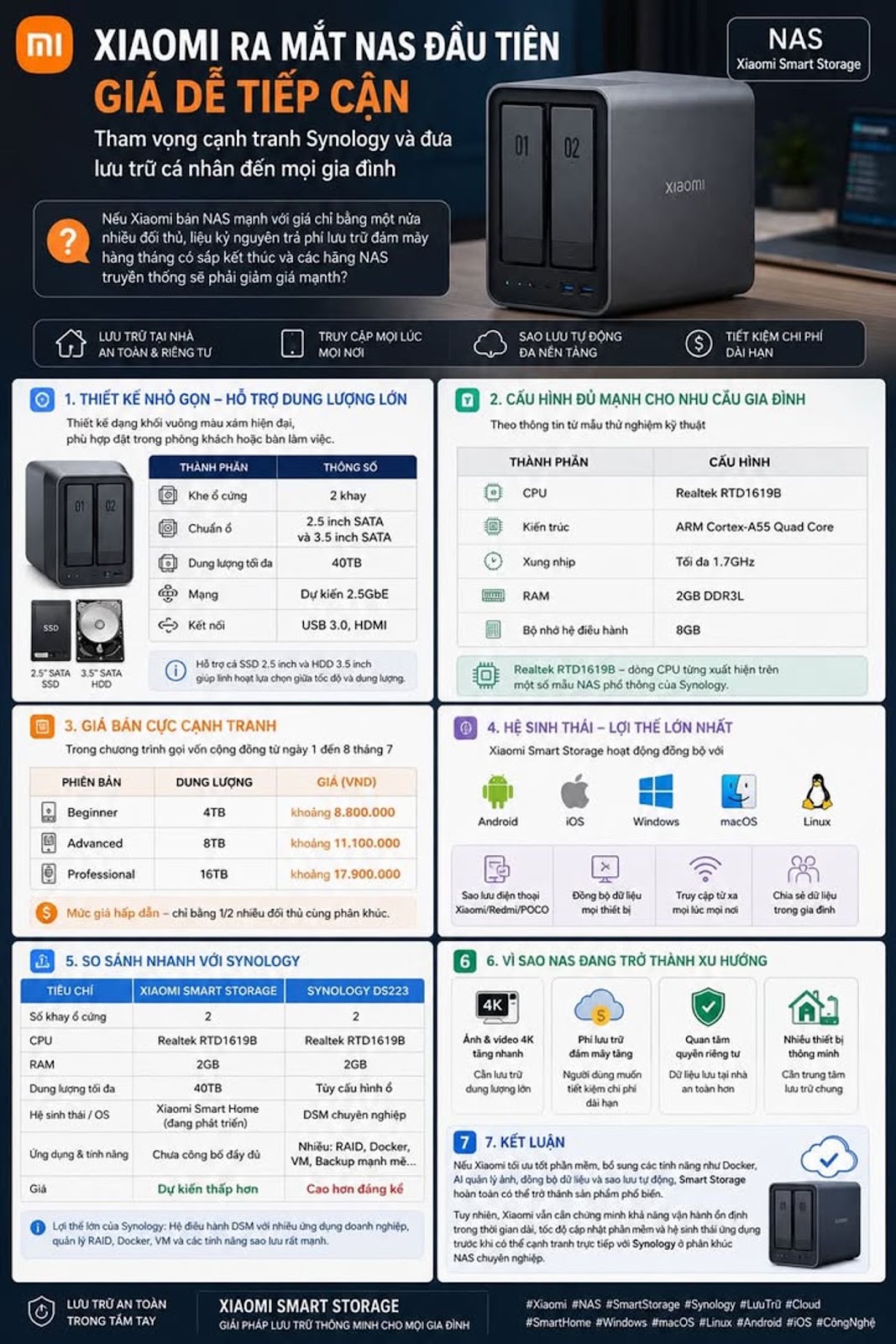
If Xiaomi sells powerful NAS at half the price of many competitors, will the era of paying monthly cloud storage fees be coming to an end and traditional NAS brands will have to drastically reduce prices?
Xiaomi officially entered the NAS market with its first product called Xiaomi Smart Storage. This is considered one of the company's most notable steps in 2026 as the need to store photos, 4K videos, AI data and device backup is increasing sharply.
Unlike many NAS systems that are aimed at professional users, Xiaomi chooses a more popular strategy by focusing on accessible prices, minimalist design and simple usability for homes, small offices as well as individual users.
Compact design but supports large capacity hard drives
Xiaomi Smart Storage uses a modern gray square design, suitable for placing in the living room or desk.
Support equipment
Component Parameters
2-tray hard drive slot
Standard 2.5 inch SATA and 3.5 inch SATA drives
Maximum capacity 40TB
Network Expected 2.5GbE
USB 3.0, HDMI connection
Support for both 2.5-inch SSDs and 3.5-inch HDDs gives users the flexibility to choose between speed or storage capacity.
⚙️ Configuration strong enough for family needs
According to information from the technical test sample, Xiaomi Smart Storage is investigatedsuffer
Configuration Component
CPU Realtek RTD1619B
ARM Cortex-A55 Quad Core architecture
Maximum Clock 1.7GHz
RAM 2GB DDR3L
8GB operating system memory
This is also the processor line that has appeared on some popular Synology NAS models, showing that Xiaomi aims for stable performance instead of racing configurations.
Extremely competitive selling price
During the crowdfunding program from July 1 to 8, Xiaomi announced three versions
Version Capacity Price
Beginner 4TB is about 8,800,000 VND
Advanced 8TB is about 11,100,000 VND
Professional 16TB is about 17,900,000 VND
This price is considered quite attractive compared to many NAS systems of the same capacity on the market.
The ecosystem is the biggest advantage
Xiaomi says the device will work in sync with
* Android
* iPhone iOS
* Windows
* macOS
* Linux
This makes backing up data from Xiaomi, Redmi, POCO phones as well as other devices much more convenient.
Quick comparison with Synology
Xiaomi Smart Storage Synology DS223 criteria
Number of hard drive bays 2 2
CPU Realtek RTD1619B Realtek RTD1619B
RAM 2GB 2GB
Maximum capacity 40TB Depending on drive configuration
Professional Xiaomi Smart Home DSM ecosystem
Expected Price Lower Significantly Higher
Currently, Synology's biggest advantage is still the DSM operating system with many enterprise applications, RAID management, Docker, Virtual Machine and very strong backup features. Meanwhile, Xiaomi has not yet fully announced its software platform, so this will be the deciding factor in competitiveness.
Why is NAS becoming worse?trend practice
Impact Trends
4K photos and videos go fast Large storage is required
Cloud storage fees increase Users want long-term cost savings
Pay attention to your privacy Data stored at home is safer
Many smart devices Need a common storage center
If Xiaomi optimizes the software well, adding features such as Docker, AI photo management, data synchronization and automatic backup, Smart Storage can completely become a popular product the same way the company did with robot vacuum cleaners, cameras or Wi-Fi routers.
However, Xiaomi still needs to prove its long-term stable operation, software update speed and application ecosystem before it can compete directly with Synology in the professional NAS segment.
#Xiaomi #SmartStorage #NAS #Synology #CloudStorage #Storage #SmartHome #Windows #macOS #Linux #Android #iPhone #Technology #TimKiemTop