#Samsung #GalaxyA18 #SamsungGalaxyA18 #GalaxyA18_4G #HelioG99 #Android17 #OneUI9 #Geekbench #SamsungGalaxy #Smartphone #TinCongNghe #DienThoaiSamsung
Samsung can sell a new generation Galaxy A in 2026 but still use a hardware platform that appeared many years ago, will Android 17 and One UI 9 be enough to make users accept this strategy?
1. Galaxy A18 4G suddenly appeared on benchmark
Samsung Galaxy A18 4G is gradually being revealed through benchmark data, thereby revealing the first information about the configuration of the popular smartphone model that succeeds the Galaxy A17 4G.
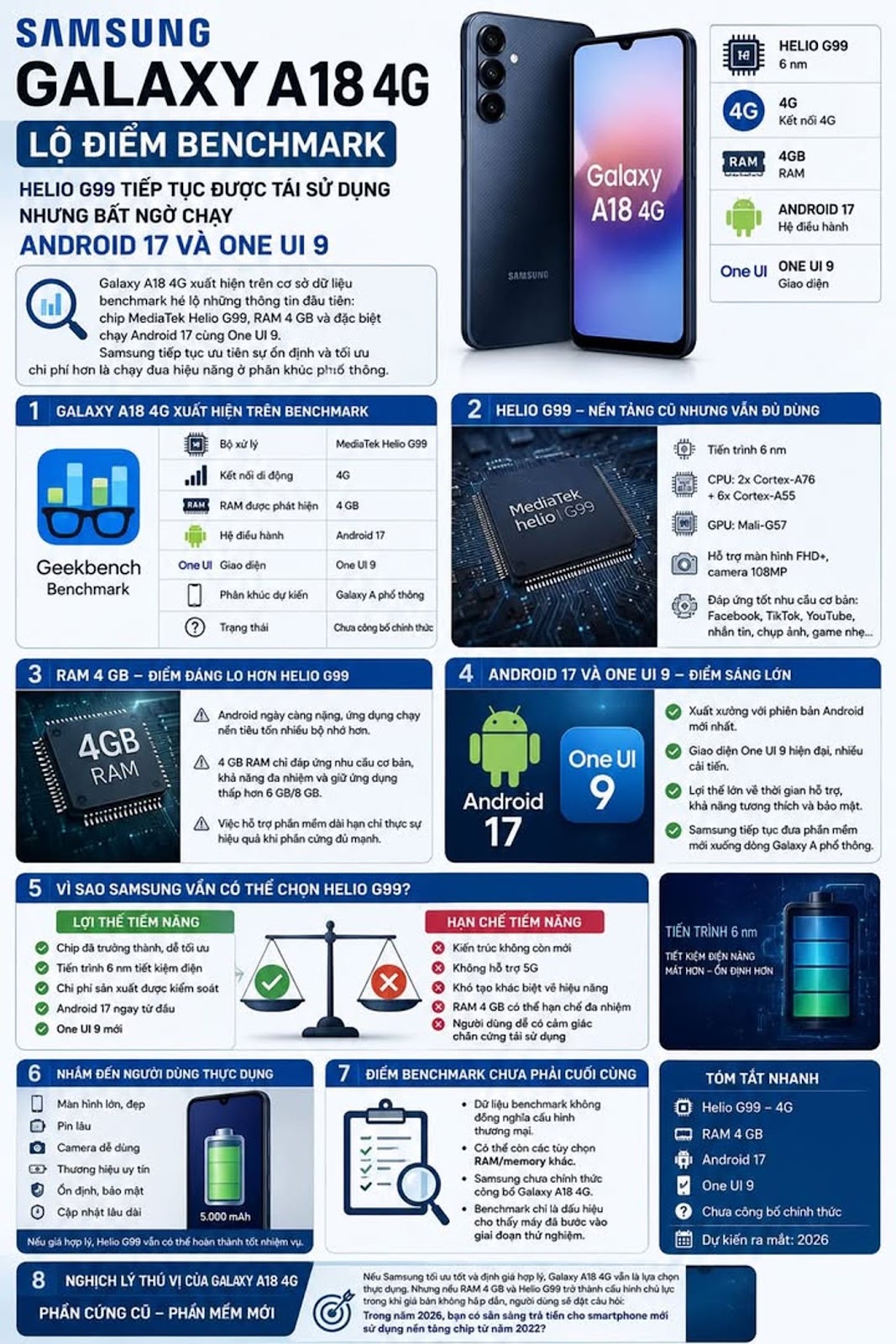
According to information posted by Android Headlines, the device said to be Galaxy A18 4G has appeared in the benchmark database with some notable details including MediaTek Helio G99 chipset, 4 GB RAM and especially Android 17 operating system combined with One UI 9 interface.
The biggest point of debate is not the software but the processor.
Helio G99 is not a new platform. This is a 4G chip that has been introduced by MediaTek since 2022 and has appeared on many popular Android smartphones. If the commercial Galaxy A18 4G really continues to use Helio G99, Samsung is showing that it prioritizes stability and cost optimization rather than racing to upgrade performance in this segment.
2. Helio G99 continues to live on a new generation of Galaxy A
MediaTek Helio G99 is produced in progress6 nm and uses a CPU architecture consisting of two high-performance Cortex-A76 cores combined with six energy-saving Cortex-A55 cores. The included GPU belongs to the Mali-G57 series.
This is still enough configuration to meet basic needs such as Facebook, TikTok, YouTube, texting, video calling, taking photos, payments and some popular games at the appropriate settings.
However, the problem with the Galaxy A18 4G lies in the market expectations of 2026.
Galaxy A18 4G category according to benchmark
MediaTek Helio G99 processor
4G mobile connection
RAM detected 4 GB
Android operating system 17
One UI 9 interface
Expected segment: Popular Galaxy A Smartphone
Status Not officially announced
The fact that a 2026 generation smartphone still uses Helio G99 will certainly create many mixed opinions, especially when the low-cost Android market is shifting strongly to newer chips and 5G connectivity.
3. The new 4 GB RAM is a more worrying detail than the Helio G99
If the benchmark configuration reflects a commercial version of the Galaxy A18 4G, the 4 GB RAM could become a notable weakness.
Android is getting heavier as social media apps, browsers, Google services, and smart features running in the background consume more memory.
4 GB of RAM can still meet basic needs, but the ability to keep many applications in memory will be difficult to compete with smartphones with 6 GB or 8 GB RAM.
This is especially notable as Samsung is aiming for a long-term software support policy across many Galaxy lines. A phone that's been updated for years is only really worth a millionIf the hardware is still capable of operating well in future Android versions.
4. Android 17 and One UI 9 became big highlights again
If the benchmark data is accurate, the Galaxy A18 4G could ship with Android 17 and One UI 9.
This is an important detail because Samsung seems to be continuing to bring new software versions to popular Galaxy A devices instead of just reserving new improvements for Galaxy S and Galaxy Z.
A low-cost device running a new version of Android out of the box will have a significant advantage in support time, app compatibility, and security patches.
The Galaxy A18 4G could therefore become quite an interesting case where the hardware is conservative but the software is very new.
5. Why can Samsung still continue to choose Helio G99
Reusing a chip platform does not necessarily mean the product fails.
The Helio G99 has been around long enough that Samsung and MediaTek have had plenty of time to optimize firmware, power consumption, temperatures, and compatibility.
Component costs can also be significantly lower than moving to a completely new platform.
For the Galaxy A18 4G, Samsung may be pursuing a formula that focuses on price, screen, camera, battery life, software and update time instead of benchmark performance.
Potential advantages Potential limitations
The chip is mature and easy to optimize. The architecture is no longer new
The 6 nm process is still relatively energy efficient. Does not support 5G
Production costs can be controlled Hard to differentiate performance
Android 17 from the start 4 GB RAM can limit multitasking
New One UI 9 Users easily feel like hardware is reused
6. Galaxy A18 4G can target a completely different user group in the configuration race
Not all smartphone buyers need high benchmark scores.
In the popular segment, a large number of customers are more interested in large screens, long-lasting batteries, easy-to-use cameras, familiar brands, stability, security and long-term updates.
Samsung has a huge advantage in these factors.
If the Galaxy A18 4G is priced reasonably, the Helio G99 can still complete the task. On the contrary, if the product price approaches 5G smartphones with 6 GB or 8 GB RAM and a more powerful chipset, this configuration will become a problem.
7. Benchmark scores are not final configuration
An important detail to note is that benchmark data does not mean Samsung has confirmed the Galaxy A18 4G configuration.
The test device can use 4 GB RAM while the commercial version also has other memory capacity options.
Samsung has not officially announced the Galaxy A18 4G, so the current information should be considered leaked data before launch.
However, an appearance on a benchmark is often a sign that the device's software development and hardware testing process has entered a notable stage.
8. Galaxy A18 4G is creating an interesting paradox
The most notable point of the Galaxy A18 4G can be summed up by a quite obvious paradox.
Old hardware but new software.
Helio G99represents a familiar platform in the mainstream smartphone market, while Android 17 and One UI 9 represent a new generation of software.
If Samsung optimizes performance, adds a quality screen, large battery, stable camera and offers a competitive price, the Galaxy A18 4G still has a chance to become a practical choice.
But if 4 GB RAM and Helio G99 become the main configuration while the price is not attractive enough, users have every reason to question whether Samsung is optimizing the product or simply extending the life cycle of old hardware.
Galaxy A18 4G can therefore become one of the most controversial Galaxy A smartphones when it officially appears. The big question is no longer whether the Helio G99 can run Android 17 or not, but in 2026, how willing are users to pay for a new smartphone using a chip platform from 2022?
#SamsungGalaxyA18 #GalaxyA18 #GalaxyA18_4G #Samsung #HelioG99 #MediaTek #Android17 #OneUI9 #GalaxyA #SamsungGalaxy #Smartphone2026 #DienThoaiSamsung #TinCongNghe #CongNghe #Android #Benchmark #Geekbench