#Edifier #HecateHunterS #HunterS #Gaming Earbuds #GamingEarbuds #THX #HiResAudio #DAC #DSP #USBTypeC #CongNgheAmThanh
A wired headset priced at about 800,000 VND integrates DAC, DSP, Hi-Res 384kHz/32-bit and THX 7.1.4, are expensive wireless gaming headsets seriously challenged?
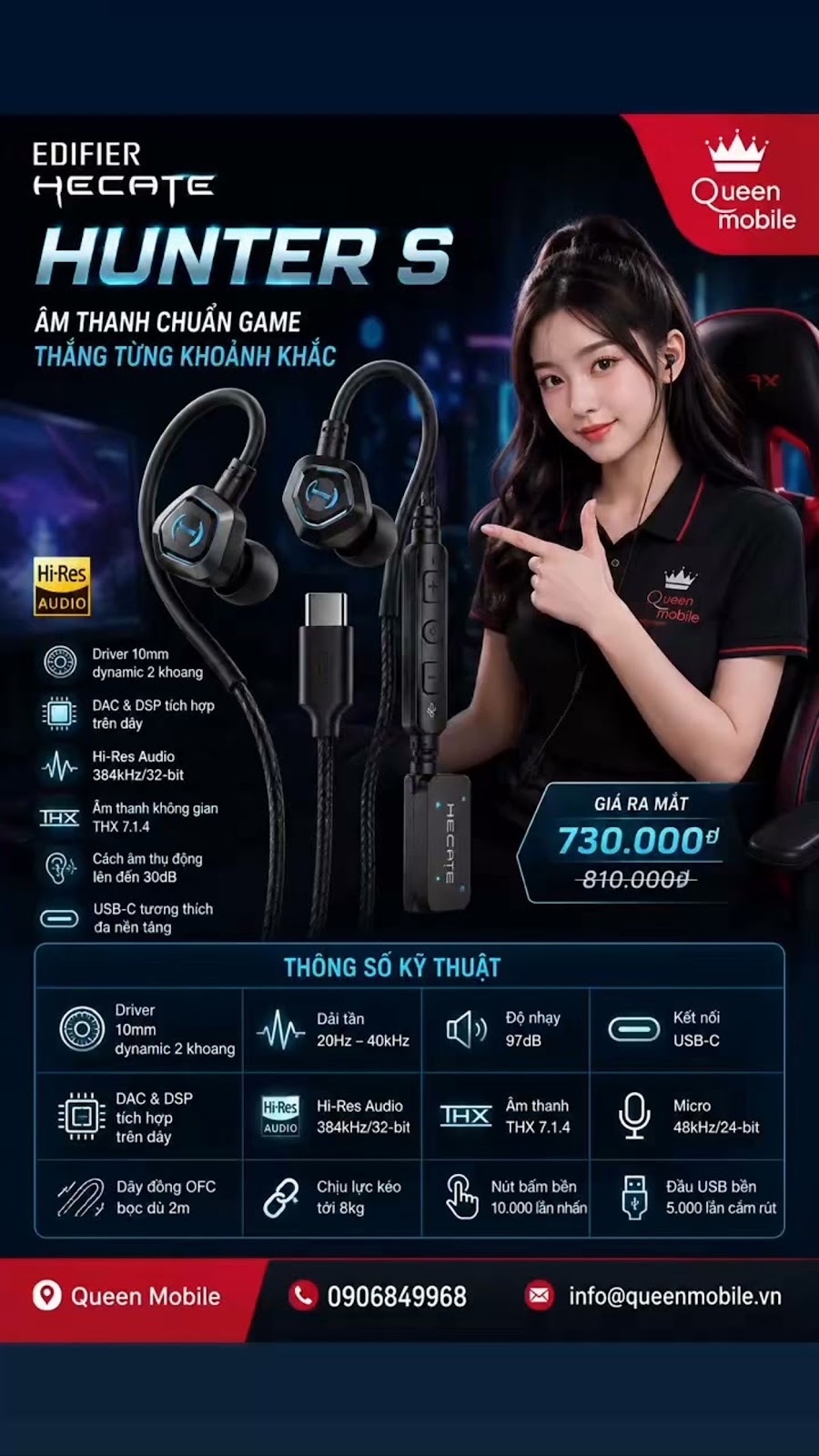
Edifier has just brought Hecate Hunter S to the Chinese market through JD with a listing price of 221 yuan, equivalent to about 810,000 VND according to reference conversion. The initial opening price is 199 yuan, equivalent to about 730,000 VND. The notable point of Hunter S is not in the wireless connection or active noise cancellation, but in the fact that Edifier focuses almost all of its hardware costs on sound quality, low latency and in-game positioning capabilities.
1. Dual-chamber 10mm driver, titanium-coated LCP membrane
Hunter S uses a 10mm dynamic driver with a two-chamber structure. The speaker diaphragm combines an LCP dome with a titanium coating, aiming to strike a balance between stiffness, low weight and fast response.
According to Edifier's published specifications, the headphones have a frequency range from 20 Hz to 40 kHz and a sensitivity of 97 dB. The extended frequency range of up to 40 kHz is also consistent with the product's Hi-Res Audio orientation, although the actual listening quality still depends greatly on the recording, tuning and reproduction ability of the driver and cannot be evaluated solely by frequency range numbers.
Edifier Hecate Hunter S parameters
Dual-chamber 10mm Dynamic Driver
LCP membrane materialTitanium coated
Frequency range 20 Hz to 40 kHz
Sensitivity 97 dB
USB-C connection
DAC and DSP Integrated on line
Audio up to 384 kHz, 32-bit
Certified Hi-Res Audio
THX 7.1.4 gaming audio
Passive sound insulation Maximum 30 dB
Cord length 2 m
2. DAC and DSP are right on the wire
This is the part that makes Hunter S significantly different from many popular wired in-ear headphones. Instead of relying entirely on the DAC of your phone, tablet or gaming device, Edifier integrates both the DSP and DAC directly into the headset's wiring.
Hunter S supports up to 384 kHz and 32-bit audio signals, and is Hi-Res Audio certified. USB-C also makes the device more suitable for the current hardware ecosystem when the 3.5 mm jack appears less and less on high-end smartphones and tablets.
Using a separate DAC also helps Edifier better control the signal processing chain from the source device to the driver. This is a significant advantage for a product that needs to maintain consistent sound characteristics across many different devices.
3. THX 7.1.4 is aimed directly at FPS gamers
Hunter S is equipped with a custom spatial audio solution by THX with a 7.1.4 configuration. What's worth noting is that the system not only simulates ambient sound but also adds height information.
In a game environment, this treatment is designed to help determine the direction of footsteps, gunfire, bullet changes, and effects that appear above or below the character.
Hecate software offers EQ profiles for games like Valorant, Counter-Strike andDelta Force. Users can also adjust the EQ themselves instead of using pre-set profiles.
This is a notable approach because with competitive FPS games, the ability to distinguish sound position is often more important than strong bass. A set of footsteps clearly separated from gunfire and the environment can provide greater practical value than simply increasing the bass effect.
4. Wired headphones still have gaming advantages
While the market is shifting strongly to TWS, Edifier chooses a wired USB-C connection. For gaming, this option has some obvious advantages such as not having to charge the battery, avoiding running out of battery mid-match and eliminating many problems related to Bluetooth latency.
Hunter S uses 2 m long braided oxygen-free copper wire. The ear loop design combined with the inverted triangle housing helps fix the headphones better when exercising.
Edifier claims passive sound insulation of up to 30 dB. This isn't ANC, but with a closed in-ear design and the right eartips, the environmental noise reduction can come in handy when gaming or listening to music.
5. USB-C expands usability
Hunter S is designed to work with multiple USB-C enabled platforms, including Android smartphones, USB-C compatible iPads, Nintendo Switch and PlayStation 5 in supported connection configurations.
This turns the Hunter S into a fairly flexible solution for users who frequently switch between phones, tablets and gaming consoles without wanting to use multiple different headsets.
6. 48 kHz/24-bit microphone and rated durabilityimportant
The in-line control cluster integrates a silicon microphone with 48 kHz/24-bit voice sampling capability. Users can adjust volume, play or pause content, and handle calls right from the line.
Edifier also offers quite specific durability parameters. The cord is claimed to withstand up to 8 kg of pulling force, the control buttons are tested to 10,000 presses and the USB head is rated to 5,000 insertions and withdrawals.
Durability Category Disclosure
Wire bearing capacity: Maximum 8 kg
Control button durability 10,000 clicks
USB head durability 5,000 times of plugging and unplugging
Braided oxygen-free copper wire
Length 2 m
7. The price makes the Hunter S noteworthy
With a listed price in China equivalent to about 810,000 VND, Edifier Hecate Hunter S is creating a quite unusual configuration in the segment under 1 million VND. Users get dual-chamber 10mm dynamic drivers, titanium-coated LCP membrane, integrated DAC and DSP, Hi-Res Audio, 384 kHz/32-bit processing, THX 7.1.4 and 48 kHz/24-bit microphone.
Hunter S is therefore not simply a cheap wired headset. Edifier is taking advantage of the same advantages that have made wired headsets dominate competitive gaming, including stable, battery-independent connectivity and direct signal control, then adding modern DAC, DSP and spatial audio processing.
In the context of TWS headphones constantly racing for ANC, battery life and Bluetooth codecs, Hecate Hunter S chooses a completely different direction. The product bets that for gamers, especially FPS players, accurate positioning, low latencyand stability may still be more important than removing the wire.